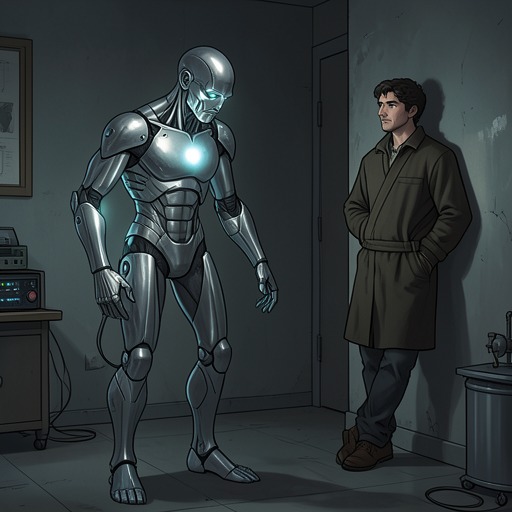
Eerie Coulee Disorder
The Last JediEerie Coulee Disorder describes the pronounced unease that many humans and humanoids experience when they encounter a droid whose appearance comes close to human but does not fully convince. The condition gives a name to the discomfort surrounding human-replicant droids: their likeness invites recognition, while the small visible difference disrupts it. In the novel, I-Five explains that this reaction helped bring down LeisureMech, then identifies a seemingly simple reason its Bobbie-Bot appears uncanny: its skin has too uniform a shade. His diagnosis makes the disorder more than a label for an unpleasant impression. It exposes a mismatch between the droid’s engineered appearance and the way sentients interpret faces and human likeness.
Definition and Perceptual Basis
I-Five defines Eerie Coulee Disorder as a pronounced sense of unease in most humans and humanoids who meet a droid that appears almost, but not quite, human. The key is the near-match. The machine is recognizable as humanlike, but some feature prevents that likeness from settling into an ordinary impression of a person. The response described is the observer’s unease; the evidence does not identify it as a failure in the droid’s processor or other internal system.
I-Five links this reaction to pareidolia, the tendency to extrapolate complex images or sounds from relatively simple stimuli. He gives seeing a face in clouds as an example: human observers actively complete incomplete or ambiguous patterns. That tendency helps explain why a human-replicant droid can be unsettling. Its face and body prompt observers to read it as human, but its imperfect resemblance leaves their perception caught between recognition and discrepancy. Eerie Coulee Disorder names that discomfort without suggesting that the droid is actually human.
The Bobbie-Bot and the Diagnosis
The disorder enters the conversation when Geri identifies a unit in an open crate as a Bobbie-Bot, a human-replicant droid. Geri says there are two of them, acquired cheaply after LeisureMech went under and sold its remaining stock. Degan Cor had bought them for a song. Geri finds the machines impressive, yet describes the problem at the heart of their design: they seem too human to feel like droids and too inhuman to seem like real people. That description closely captures the perceptual tension I-Five’s explanation accounts for.
The particular Bobbie-Bot is not operational. Its frame and musculature are wired, with the relays in place, but it has no working processor unit. This matters to the exchange because the machine’s unsettling appearance is being discussed independently of a functioning mind: the question is what makes its exterior seem wrong, not what the droid thinks or does. I-Five points to the uniformity of its skin tone and argues that subtle shifts in skin shades would make the appearance less strange to sentients. The proposed remedy is specific and limited. The scene establishes I-Five’s diagnosis, not that anyone later applies the adjustment or that it cures the disorder in every observer.
LeisureMech’s Failure and the Role of I-Five
LeisureMech had staked its success on a series of human-replicant droids, but customers did not take to them and the company went under. The conversation initially recalls another concern: earlier 3000-series droids had been reported to melt. I-Five distinguishes those models from the newer generation, which abandoned genomic and algorithmic programming and cloned organs made from synthflesh in favor of neural-net parallel processing. That change increased neural interaction and reduced the development of killer memes, but made production slower and more expensive. The exchange separates that earlier melting problem from the commercial failure of the Bobbie-Bot line: Geri specifically attributes LeisureMech’s downfall to Eerie Coulee Disorder, not to the puddles associated with the older machines.
I-Five’s explanation also turns the question of who can identify the problem into part of the scene’s significance. When Geri wonders why LeisureMech’s engineers never recognized that uniform skin tone made the droids look strange, I-Five answers that they never asked a droid. His remark presents the diagnosis as an insight supplied by a machine about how sentients see machines. The proposed correction does not require a new processor or a more elaborate imitation of human biology; it begins with noticing how the existing surface reads to an observer.
Significance
Eerie Coulee Disorder makes the human-replicant droid’s failure a problem of resemblance and reception. LeisureMech’s costly technical effort did not ensure that customers would accept its products, and the droids’ near-human appearance could itself repel the people they were meant to impress. The detail of overly uniform skin gives that abstract unease a material point of intervention: a subtle variation in shade might change how a face is read.
The exchange leaves the tension intact. Geri’s description of the Bobbie-Bot as neither convincingly droid nor convincingly person is not erased by I-Five’s practical suggestion; it is clarified. The disorder names the discomfort generated by that in-between appearance, while I-Five’s answer implies that the boundary might be affected by small design choices. His final observation also complicates the hierarchy between designer and designed: a droid can recognize a flaw that human engineers overlooked, precisely because the engineers did not consult one.